Here are three simple, evidence-based quick wins for any online fundraising effort!

Interested in the details? Check out the full deck here, with specific instructions on how to set individual donation amounts on page 5:
 Donanto Foundation
Here are three simple, evidence-based quick wins for any online fundraising effort!
Interested in the details? Check out the full deck here, with specific instructions on how to set individual donation amounts on page 5:
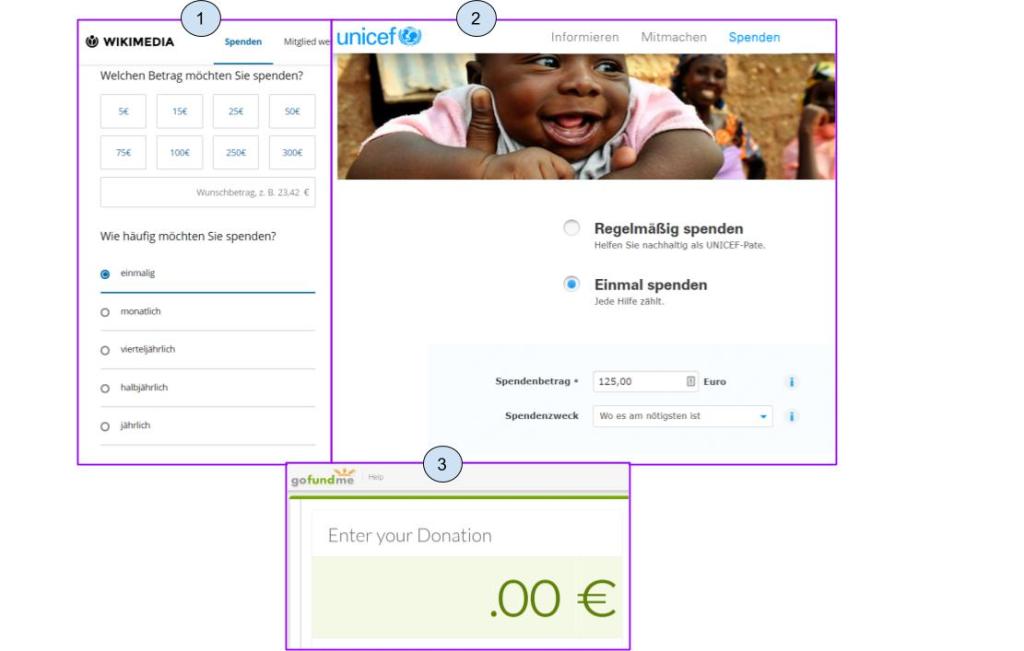
Some charities give potential donors lots of flexibility when donating online (see below for example 1 by Wikimedia). After all, people love flexibility, right? Then why would anyone limit donors’ choices, e.g., by pre-filling the online donation form like Unicef does it with a very structured form (see example 2 below)? Ideally, you would give donors maximum flexibility by leaving everything up to the donor, as GoFundMe does it (see example 3), right?
Well, I used to think the same way, because consumers would tell us in focus groups and interviews how much they value freedom and flexibility.
However, when we would actually test both alternatives separately (i.e., one group of consumers would only see a very flexible choice and another group of consumers would only see a very structured choice), in every single case, more consumers would choose the structured choice!
Initially, our clients and we were so shocked by these counterintuitive results that we invested in a brain scan study to find out what secret thoughts drove consumers’ choice. As we have described in an article on LinkedIn, structured choice (what we often call “bundled portfolios”) clearly outperforms the “build-it-yourself” or flexible choice in terms of mental “attention” required. “Attention” is mentally demanding and leads to choice stress, which ultimately lowers the attraction to buy.
How much lower? Well, since this issue came up in many of my projects as a management consultant for leading telecommunication and insurance firms, banks, utilities, etc. I was able to test this about ten times. The results: By deploying a flexible choice for consumers, you leave between 40% and 80% of revenue on the table as opposed to a structured choice. Those tests were conducted in the context of commercial subscription products (something I shared on LinkedIn here).
Does this apply to online donations? Initial evidence says yes: A/B pre-tests with online donations I have conducted suggest very similar outcomes!
For now, let’s note my first cardinal rule for online donations:
Do not give donors too much choice in the donation form (even if they tell you that they want that choice).
Stay tuned for more rules to come…
After I had offset the CO2 emissions of our family summer vacation, I also wanted to better understand what more we could do personally to cut our emissions. I found all sorts of resources on the web, but they seemed either much too broad or much too narrow in focus.

Instead, I was looking for a concise, quantitative, prioritized list of key CO2 emission sources that I could concentrate on. I was so intrigued by this idea I even drafted a dummy version (see screenshot below):
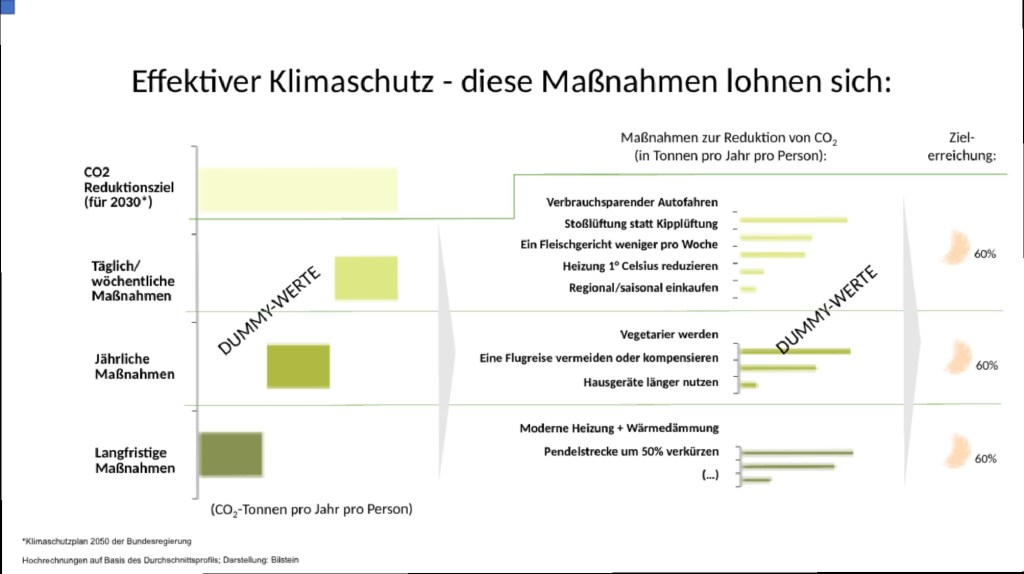
A number of specialized NGOs I contacted with this dummy version really liked the concept, but did not have anything ready to share. So I ended up researching the facts myself during one internal meeting that was particularly boring.
Turns out there is an incredible amount of well-researched data on CO2 emissions available out there at your fingertips! However, you really have to be a data-savvy expert to make sense of it! So I invested a few hours to research the most important facts and compiled them in a simple spreadsheet. Then I had an enthusiastic colleague (Carsten) help me out triple checking the facts and expanding the list.
That initial analysis contained quite a few surprises for me personally: For example, I had substantially under-estimated the CO2 impact of switching to a vegetarian diet! And I was very surprised to learn that avoiding plastic bags had basically zero impact on my CO2 emissions.
I started wondering if my fellow citizens had the same misconceptions on what were the key levers to cut personal CO2 emissions. Since easy-to-use insights were inaccessible and most lists lacked numbers, it seemed only natural that everyone would be just as clueless as myself.
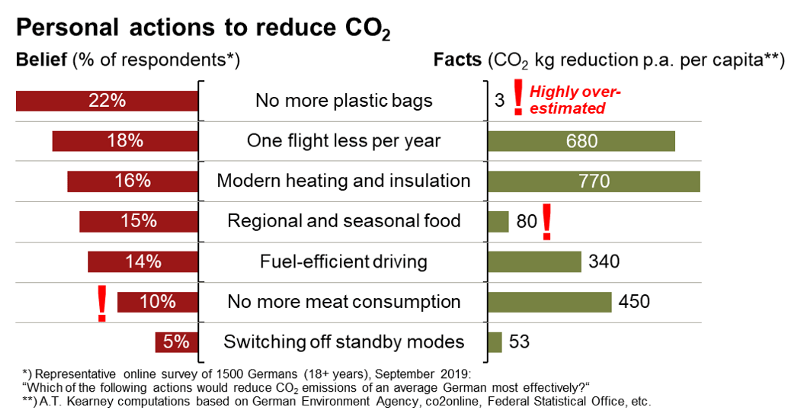
Five surveys (with a total of more than 6,000 respondents in four countries) later, we were able to confirm that hypothesis! Our most striking finding: People across the world believe that avoiding plastic bags is actually by far the most important personal lever to cut CO2 emissions.
When we published those findings in a simple blog post on LinkedIn, things got really wild: the post generated 10x more views than my next best post and its core graph gathered thousands of likes on Reddit within a few hours. Within a few days, the story got picked up by multiple national media outlets as well as a few international ones like Wired UK or Treehugger.

The most beautiful and fun implementation of our findings was done by Handelsblatt, Germany’s leading business daily: Not only did they publish our insights in their “graph of the day” category covering two full pages, but they also created an animated version here.
Which personal action has the strongest impact on reducing the CO2 footprint of an average American or German? Turns out this question is surprisingly difficult to answer for most of us. And what are the next best five or ten things we should do to cut CO2? There is surprisingly little guidance out there. Because of that, I fear that we may not manage to cut emissions as much as we have to. That’s why Carsten and I did the legwork for you!
I have to admit that Greta got to me. Perhaps because I also have a daughter some consider to be on the spectrum as well (remember Greta’s hate speech at the UN?…“how dare you”…we get this regularly when we ask our daughter to lay the table). So what does a management consultant do if he wants to take personal action on CO2? Look for a concise, quantitative, prioritized list of key drivers that he can select from (since CO2 footprints differ by country, we looked for German information). There is a ton of information out there, but it is usually in one of the following categories:
But thanks to all these lists and useful calculators, we were able to come up with the following overview quickly. It is still work-in-progress, not perfect at all, and sometimes we have conflicting data points, but hey, it’s a start.
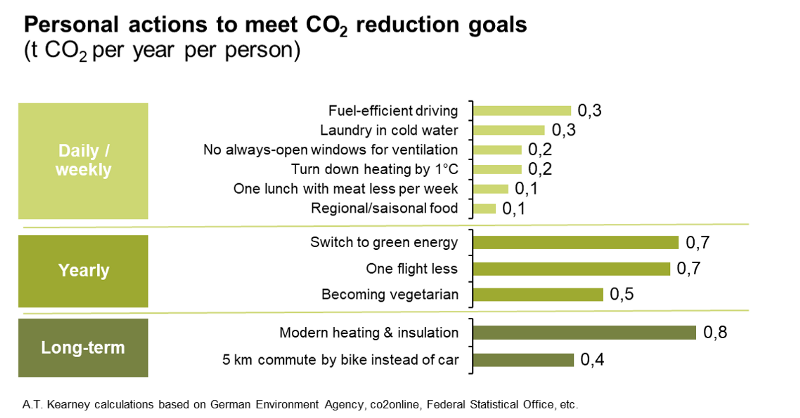
We have grouped the actions into
As a vegetarian household with top-notch heating and insulation, with an electric car, green electricity, and no daily car commute, I can check off many actions on that list. However, some drivers were new to me, like washing clothes in cold water. The good news is that if I implement all these levers, I will achieve about 75% of the reduction target defined by the government for 2030! How cool is that?!
And now comes the bad news.
We asked 1500 Americans and 1500 Germans to select from a list of seven personal actions the one that has the strongest impact on reducing the CO2 footprint of an average person. Here comes the list:
We presented the list to respondents in a randomized order, but the list above is in descending order of impact. For example, in Germany, the impact of energy-efficient heating & insulation on our CO2 footprint is a whopping 250 times bigger than stopping to use plastic bags.
Guess which action was selected most often in Germany? “No more plastic bags”! Seriously?!
Here is the drama in all its gory details:
We were hoping that this is due to Germany’s unique obsession with recycling trash since the 1980s. But “no more plastic bags” actually made it to number 2 on the list in the US as well, very close behind fuel-efficient driving. Here is the comparison between both countries:
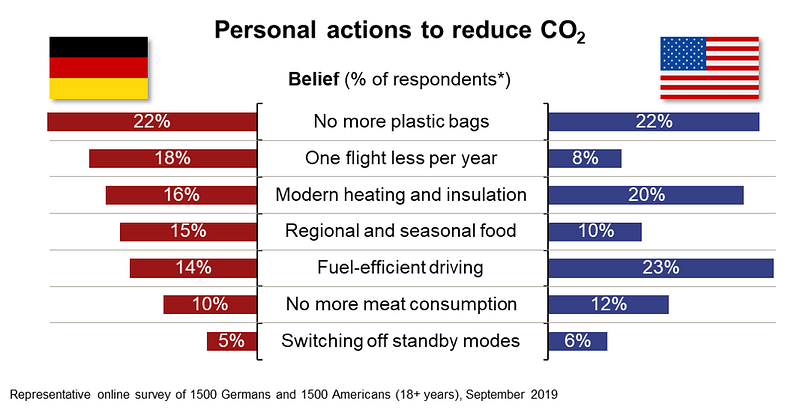
It is difficult to say who is more clueless because both countries have their specific blind spots: That “one flight less per year” comes out so low in the US is just as ridiculous as the fact that meat consumption is not seen as a source of CO2 in Germany.
I wish I had taken the survey myself before doing the math on the actual drivers. I am certain I had my fair share of ignorance! For example, I grossly overestimated the effect of having no daily commute to work.
But we are not here to poke and pry, but rather to drive action! So now that I know all the numbers, I have pledged to substantially reduce my flights!
 Donanto Foundation