Categories
Climate Crisis

A Transatlantic Take on Climate, Nudges, and that Extra Steak

When Decisions Get Hacked

  1. Introduction

Let’s focus on what unites us for a change, shall we? Climate change is a transatlantic headache – big, messy, and guaranteed to spark arguments at dinner parties. Europeans love a good regulation, preferably wrapped in a 300-page report and debated over espresso. Americans, on the other hand, prefer innovation and market-driven solutions, often with a side of “we’ll fix it with technology.” Yet, despite these cultural quirks, both sides wrestle with the same fundamental dilemma: How do we make real progress without torpedoing economies? How do we keep people on board without triggering social media outrage? And most importantly, how do we stop talking about solutions and actually implement them before Miami turns into Venice?

  1. Hacking Humanity, One Nudge at a Time

Our most crucial decisions – be it in courtrooms or at climate summits – are vulnerable to tiny, well-timed nudges. Dozens of studies reveal that small, almost imperceptible changes can alter opinions as swiftly as a viral tweet. A study on 1,112 parole decisions found that judges were dramatically more likely to grant parole after their coffee break and lunch – suggesting that even critical legal outcomes can be influenced by something as simple as hunger. If justice can be swayed by a sandwich break, what does that say about our ability to make sound decisions on something as complex as climate policy? Imagine a policy proposal on CO₂ pricing facing the same kind of arbitrary fate, its success dependent not on scientific merit but on the timing of the vote or the mood of the electorate. In both Europe and the U.S., this hackable nature of decision-making forces us to ask: are we really making informed choices, or are we just following the well-timed taps on our shoulders? And if so, how can we use this approach to get us where we need to be?

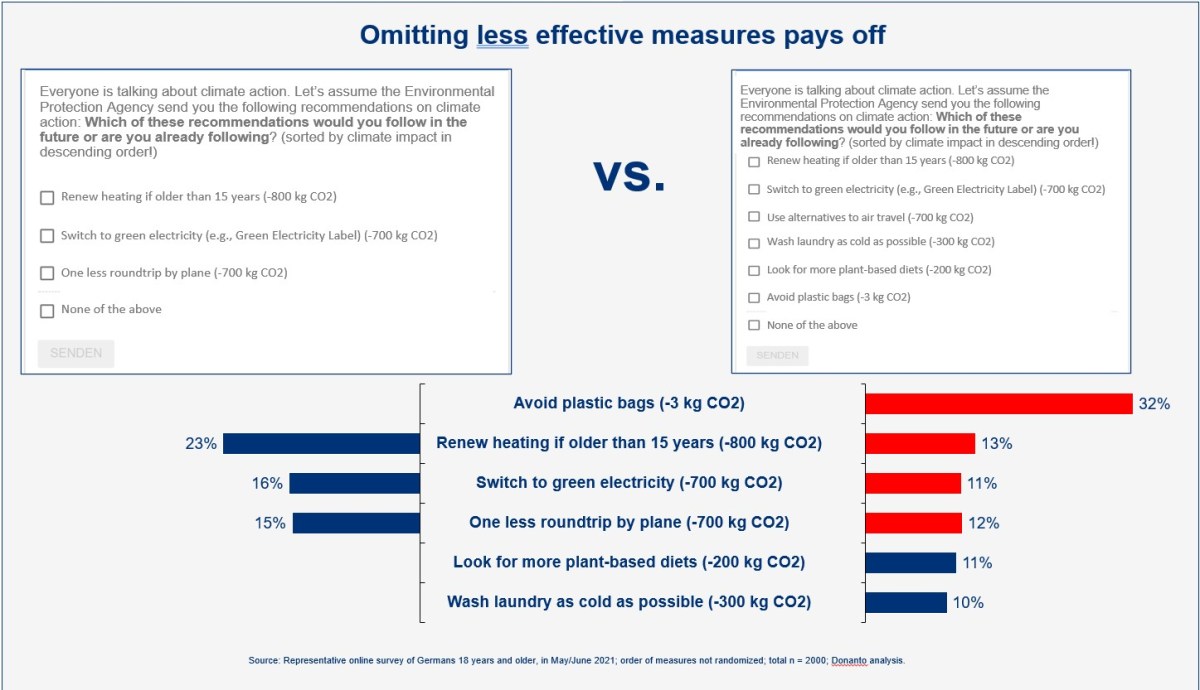
Here is a recent example from my own research: I noticed in a number of surveys with thousands of Americans and Europeans that whenever low-impact measures are presented alongside high-impact ones, the duds tend to dominate attention – regardless of their actual effectiveness. This cognitive trap dilutes focus and weakens outcomes. Therefore, the smart move is to leave the low-impact fluff off the menu entirely – because if it’s on the table, it steals the spotlight.

  1. A Side of Meat: Appetite, Underestimation, and Transatlantic Taste

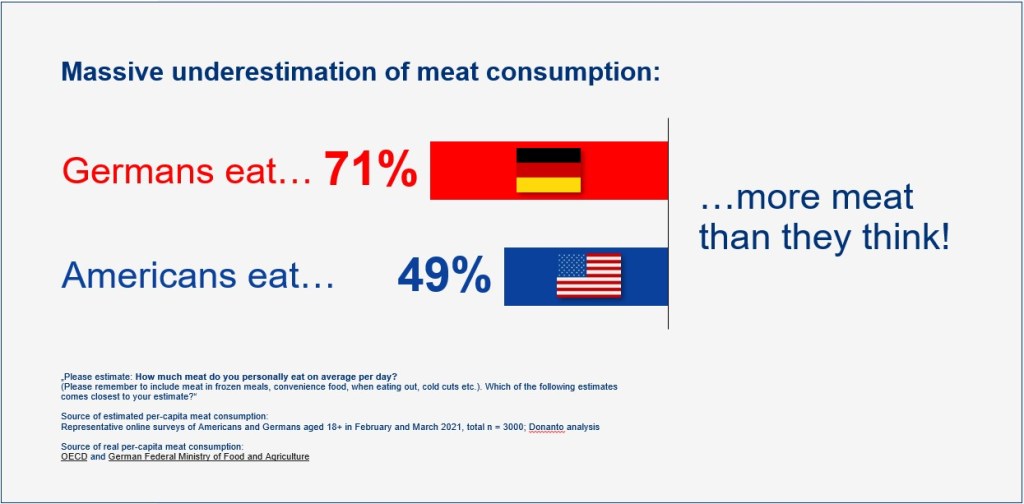
One facet of our climate conundrum is that we sometimes just deny reality. My corresponding example comes served with a generous helping of irony – meat consumption. My surveys with more than 3,000 respondents indicate that both Americans and Germans dramatically underestimate how much meat we actually eat, but there is still a difference: Germans eat 77% more meat than they think, while Americans eat close to 50% more. In Europe, this underestimation might be a nod to a more measured approach, as if to say, “Yes, we consume, but we consume with restraint.” Across the Atlantic, however, the unspoken truth is that the U.S. may be feasting on burgers with an almost celebratory abandon. This disparity not only provides fodder for humorous banter at dinner parties but also highlights a deeper cultural divergence: while Europeans might engage in polite self-deprecation about portion sizes, Americans often have a robust, unapologetic appetite that spills over into their approach to policy and law.

  1. Facts, Figures, and the Illusion of Knowledge

One might think that more information equals better decisions, but it’s not the sheer volume of climate facts that matters – it’s understanding the effectiveness of the measures we propose. That is one of the key insights of a new multinational study with more than 40,000 respondents. Whether it’s a CO₂ price mechanism paired with transfer payments or a complex legal reform, the key lies in knowing what works. The study showed that there was only a limited difference between the U.S. and Europe regarding this point. Now take a second and consider the last pieces of information you saw on climate issues. My bet is that, most likely, you were fed facts on the climate crisis as opposed to explanations on effective policies. 

  1. Fairness: The Unwritten Law in Policy and Precedent

At the heart of effective policy – be it environmental or legal – is a deep-seated sense of fairness. Unfortunately, only about a third of respondents in high-income countries like the U.S. and Europe consider a carbon tax with cash transfers to be fair! The most important factor in all countries (surveyed in the study mentioned above) that encourages climate-friendly behavior adoption is “The well-off also changing their behavior”! So, even amidst ideological clashes, both Europe and America ultimately converge on the idea that a policy perceived as unjust is doomed from the start. Whether you’re drafting a judicial decision or a climate policy, fairness isn’t optional – it’s the foundation upon which trust and acceptance are built. However, this is just one aspect of what makes a climate policy effective.

  1. Cutting the Fluff: Focusing on What Truly Works

Imagine wading through 1,500 governmental climate measures only to find that a mere 63 are truly effective. That’s the arduous work done by a team of researchers led by the Potsdam Institute for Climate Impact Research, using an incredibly sophisticated machine-learning based approach. The takeaway here is strikingly clear: only very few policies were effective. In both legal and climate arenas, it’s about trimming away the excess and focusing on what works. Rather than indulging in an overload of well-intentioned but largely ineffective initiatives, both American and European policymakers could benefit from a more discerning approach. 

  1. Bundling: The Secret Sauce of Policy Success

According to the study, successful state actions often come in tailor-made bundles. Think of it as the policy equivalent of a perfectly crafted cocktail: each ingredient, from strict emission regulations to economic incentives, plays a crucial role in delivering a satisfying punch. Both, in Europe, as well as across the Atlantic, while there are certainly attempts at such integration, the process sometimes feels more like an improvisational jazz session than a rehearsed symphony. The lesson? Whether in law or climate policy, crafting a winning strategy is less about isolated acts and more about the harmony of a well-curated ensemble.

  1. The Transatlantic Tango: Differences and Similarities

The transatlantic divide resembles an elaborate dance, where each side steps to a different beat yet shares the same stage. The Europeans waltz through policy debates with meticulous precision and overengineering (Green Deal, CSRD, etc.). Their American counterparts, on the other hand, often prefer a more freestyle approach – bold, brash, and occasionally a tad chaotic. Despite these stylistic differences, both continents are united by a common thread: an unwavering commitment to addressing the climate crisis, even if the methods vary – and even if public perception is at times different.

  1. Reflections on Hackable Decisions and the Future of Policy

If there’s one thing to take away from this whirlwind tour of transatlantic policy, it’s that our most vital decisions are not immune to manipulation. Whether it’s the nuanced interplay of nudges in a judge’s decision-making process or the subtle persuasion embedded in climate communication, we are all, in some ways, victims of a hackable human nature. And yet, this vulnerability also presents an opportunity. By understanding the levers that drive behavior – be it fairness, effective communication, or the clever bundling of initiatives – we can design systems that not only mitigate the risks but also harness our collective potential for positive change.

Looking forward, the challenge for both European and American policymakers is to embrace these insights without losing sight of what makes their approaches unique. In either case, the goal remains the same: to turn our hackable human nature from a liability into a strength.

So, let’s stop serving climate side salads and start dishing out the main course. If Brussels obsesses over straws and Boston ignores heat pumps, we’re all just rearranging deck chairs – real progress demands focus on what cuts carbon at scale.

(This article was initially published in the Transatlantic Law Journal, Volume 3, Issue 4, p. 145ff. My thanks go to the editors for allowing me to post it here!)

Categories
Climate Crisis

Caution ⚠️ – Green nudges can backfire!

40% of ecommerce customers increase their return shipments when informed about the negative environmental consequences of product returns! 

This is what a team from the Universities of Frankfurt and Mannheim showed in a large-scale, randomized field experiment (published here by Marketing Science, a top peer-reviewed journal). This study really stands out due to its sample size (> 100k consumers!).

That ‘s the bad news (for a summary of nudges backfiring, check out this overview). But there is also good news:

  • 👍 The dual green nudge (example in the graph below) did not affect conversion rates and overall sales negatively. 
  • 👍 The researchers were able to effectively target the green nudges to the consumers most likely to react positively, using causal machine learning. 
  •  👍 Green nudging “seems to be particularly effective for consumers who would otherwise return at an above-average level”, as the authors put it.

Also, as the authors point out, the consumers where the nudges backfires may not be anti-sustainability monsters, but simply customers that are unintentionally reminded by the nudge that returns are possible. 

So, what’s the takeaway? If you’re going to nudge, nudge wisely! This study is a good reminder that not all green nudges are created equal—some might just nudge customers straight to the return label. But with a little finesse and some causal machine learning magic, you can turn those nudges into a win-win: happy customers and a happier planet. Let’s keep it green, but also keep it smart. 🌍✌️

Categories
Climate Crisis

Will the Robot Revolution Supercharge the Climate Crisis?

Will the Robot Revolution Supercharge the Climate Crisis?

After decades of robots acting more like clumsy toddlers, we’re now on the brink of a robotic revolution that could reshape our world by 2040, much like the steam engine once did—only with fewer coal stains. The prospect is both exhilarating and alarming. Picture a future where general-purpose humanoid robots handle household chores and work tirelessly in stores and factories, leaving us to kick back and watch Netflix. But hold on to your Roombas! With plummeting manufacturing costs, skyrocketing consumption, and the inevitable rise in emissions, the stakes are higher than ever. In this essay, I’ll explore how this impending wave of robots might not just transform our lives but also turbocharge the very issues threatening our planet.

In our household with three ladies, even simple appliances get names: Our robotic lawn mower, for example, is called “Matilda”. When nobody is watching, I like to sit down and just watch Matilda mow our lawn: It is a uniquely serene sight – until Matilda gets stuck again in our Rhododendron bushes. This is Moravec’s Paradox at work (“it is comparatively easy to make computers exhibit adult level performance on intelligence tests or playing checkers, and difficult or impossible to give them the skills of a one-year-old when it comes to perception and mobility”). Many of you probably use one or two of these household robots, and you have seen industrial robots in use, so you know: For more than 20 years, nothing much has changed in robotics: They only work in a very narrow, controlled environment. 

Yet, despite Matilda’s botanical misadventures, the Robot Revolution is gearing up to leap beyond our backyards. Buckle up, because this time, it’s different. REALLY different.

I believe we are on the cusp of a “RobotGPT” moment, similar to what happened in 2020 with the advent of GPT-3 (broadly accessible, of course, in November 2022 with ChatGPT). Here’s why:

We know that the AI revolution is powered by scale, i.e., by massively increasing the data used to train the model (the key benefit of the famous multi-head attention algorithm at the heart of the transformer architecture is to dramatically lower “training cost”, i.e., enable more data crunching). Scale has produced performance improvements (like “learning to learn”) most experts did not expect. Since the 1990s, the World Wide Web enabled the creation of readily-accessible, multi-modal data on an unprecedented scale. This is now fueling the AI revolution. So far, we have been lacking a similar source of data to train our robots the necessary “foundational manipulation skills” to operate in our messy real world. This is about to change!

Here are two paths to resolve this data scale bottleneck and kickstart the Robot Revolution: 

  1. Simulations: As I argued in a conference talk in 2019, significant progress will occur when computers can simulate their learning environments digitally. This is similar to the advancement seen with AlphaGo Zero, which became unbeatable at playing Go after just 3.5 days of simulation training, starting from zero prior knowledge. Not surprisingly, Nvidia’s robotics unit, led by Peter Fox, is pursuing this approach because it demands an even greater number of GPUs than current needs.
  2. Videos: Currently, training robots using videos—a method known as “pixel-to-torques”—has not been feasible on a large scale. Replicating complex real-world actions, such as cracking an egg, through “behavioral cloning” requires enormous amounts of sensory data to control the many actuators of a humanoid robot. Despite this challenge, researchers are making progress. If we can develop high-quality training policies linked to videos that systematically address these gaps, we might be able to use the vast amounts of existing videos (not just from platforms like YouTube or TikTok, but also from surveillance and personal footage) for effective behavioral cloning.

To me, both paths look equally promising at this point, and they may even be mutually reinforcing (because simulations on a massive scale could provide exactly the missing links between robot skill training and human videos). 

Just so you know – There might be an alternative approach to training robots for effective movement: developing learning algorithms inspired by the simpler brains of organisms like dragonflies or even worms. This method could reduce the need for large-scale data, such as that used in large language models (LLMs), at least for the movement aspects of robotics. 

Whatever approach we use to teach our robots to move like us, the designated “frontal cortex” is already there: Researchers have shown how the “open-world reasoning” delivered by LLMs can be used to steer robots if we combine them with robotic actions into vision-language-action models (VLAMs) and optimize them for end-to-end robotic control. 

So, most foundational elements for unleashing the Robot Revolution are either already available or really within our grasp (including, of course, hardware elements like better sensors, actuators, batteries, 5G connectivity etc.). That was not the case only five years ago. 

That’s why I am pretty confident with my following forecast:

Before the year 2040, I expect to see widespread use of general-purpose humanoid robots, both in commercial and private settings. I expect this to happen before we see fully self-driving cars (SAE Level 5). 

When this happens (as explained, in my view, it is no longer a question of “if”), this will trigger the biggest changes in our society since the invention of the steam engine! But let’s not boil the ocean, today I would like to hone in on the Robot Revolution’s implications for the climate crisis. 

First, I will list some individual trends that will be all but inevitable assuming my forecast unfolds as predicted. Then I will outline some key uncertainties.

Robot Revolution – key trends:

  1. Lower manufacturing costs: The most obvious implication of the Robot Revolution is that in a matter of just a few years, general-purpose humanoid robots will lower labor costs dramatically (RethinkX estimates labor costs of under $1 before 2035 and under $0.10 before 2045). 
  2. More consumption: The substantial decrease in manufacturing costs as well as the massive increase in 24/7 availability will increase general consumption (as it always has throughout human history).
    → Likely effect on greenhouse gas emissions: Strong increase 
  3. More near-shoring:  The Robot Revolution will drive a resurgence of local manufacturing in today’s high labor cost-countries. This will reduce transportation costs to some degree (but local transport will still be necessary).
    → Likely effect on greenhouse gas emissions: Limited decrease
  4. More free time: People rich enough to afford a humanoid robot will experience a massive increase in their free time since most household chores can now be outsourced to a general-purpose humanoid robot. This free time will most likely be invested in activities with a large CO2 impact (like weekend travel by aircraft).
    In addition, unemployed unskilled labor will also have more free time (though that effect is much smaller).
    → Likely effect on greenhouse gas emissions: Strong increase 
  5. More robots: Needless to say, all of this will massively increase the demand for humanoid robots which need to be manufactured, delivered, and maintained.
    → Likely effect on greenhouse gas emissions: Strong increase  

I am pretty confident with the certainty and impact of those six trends. However, there are a few uncertainties, and I am curious to hear your thoughts on them.

Robot Revolution – selected uncertainties:

  1. Fewer commutes? As many service tasks will be taken over by general-purpose humanoid robots, the need for humans to commute to work may be further reduced, if many of these tasks are completely eliminated.
    → Potential effect on greenhouse gas emissions: Moderate decrease
  2. Global South? If the Robot Revolution accelerates economic development in the Global South (and that is a very big ‘if’), this would increase per-capita emissions, but at the same time likely drive educational opportunities for women and thus further accelerate the decline in birth rates.
    → Potential effect on greenhouse gas emissions: Moderate increase

Let’s step back and see the forest for the trees: the picture that emerges is one of tremendous risk. If we are unable to decarbonize our consumption habits, especially our leisure activities, the Robot Revolution is likely to supercharge the climate crisis by substantially increasing greenhouse gas emissions. If you needed yet another wake-up call to keep fighting for rapid decarbonization of our economies, consider the Robot Revolution your ultimate call to action.

Categories
Climate Crisis

Change course! – Five bold hypotheses on climate communication

Not only since the German government’s energy-saving campaign (“Dear 80 million“) have we been swamped with well-intentioned advice on how to reduce our personal carbon footprint. Most of these checklists are wild collections of measures with dramatically different effects and questionable persuasiveness. At least that’s what I thought, so I set out to prove in a series of tests that simple adjustments could improve the impact of these lists. And in doing so, I came across a whole series of surprises…

In the following I would like to show that

  1. these checklists are currently a central dimension of climate communication,
  2. we climate activists can make them measurably more effective, and that
  3. systemic measures for frequent polluters can also be communication measures.

I will do this in the form of five catchy hypotheses, each of which I will then justify in detail and in an evidence-based manner.

1.   Steer climate communication away from the general climate crisis!

In a nutshell: The question is where best to deploy our scarce climate communication resources with the greatest impact for the climate. Let’s face it: the battle to interpret the climate crisis has been won. We can now redirect the focus of climate communication.

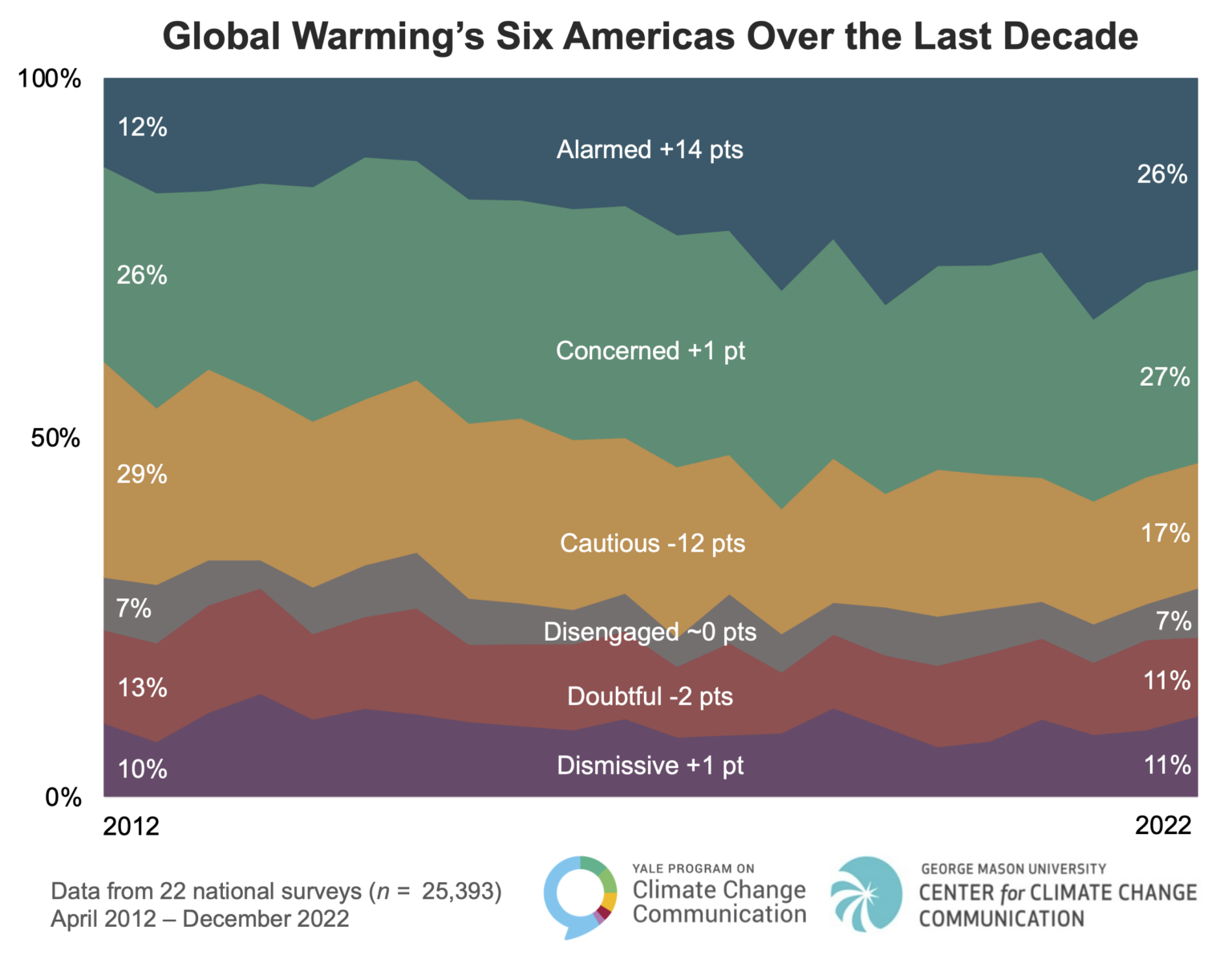
For decades, there have been evidence-based, helpful recommendations on how to convince people that the climate crisis is caused by us (wonderfully summarized on the Skeptical Science website, communication advice for IPCC researchers, university checklists, TED Talks, etc.). Apparently, they have had an impact: even in the U.S., the percentage of citizens who are “alarmed” or “concerned” about the climate crisis has increased from 38% to 53% since 2012 (Yale Program on Climate Communication). In Germany, too, not least the PACE study has shown that we have won this battle: Almost 60% of German citizens are even concerned that we will not meet the climate targets (stable since April 2022, strong/very strong concerns: 36%).

Let’s face it: There will always be a small group of climate deniers whom we can hardly convince (see also interview on klimafakten.de). However, it is not worthwhile to invest in communicating with this fringe group, because the effort required to convince them is just not worth it.

If we want to put our scarce climate communications resources where their leverage for climate is greatest, three areas are promising:

  1. Policy makers (for the legal framework of system change).
  2. Economic decision makers (for supply-side system change).
  3. Personal actions by citizens (for demand-side system change).

In what comes next, I focus on the second area, not because it necessarily has the most impact, but because of my expertise in behavioral economics.

2. Focus on measures, not on climate knowledge!

In a nutshell: The fact is that we don’t really know what we personally can do to combat the climate crisis effectively. And we are systematically lying to ourselves in the process. Changing that is difficult, and more knowledge does not seem to help. Therefore, our climate communication needs to focus on what we can do about the climate crisis.

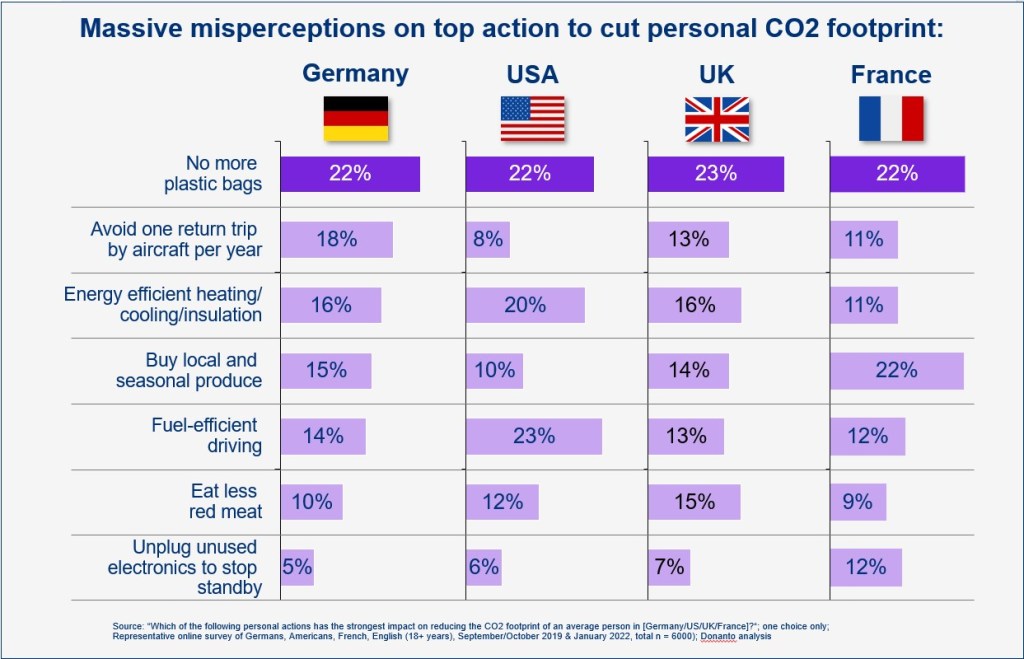
In 2019, I asked 5000 people in four countries to choose the one with the biggest CO2 impact from a list of seven personal actions. The result was shocking and found its way into many media: giving up plastic bags was at the top of the list in all countries:

This result has been reproduced several times since then (e.g. by Stiftung Warentest) and I also repeated the survey in the U.S. in early 2022 with almost identical results. This means that not only do we have no idea, but also that this is not improving (even in the PACE survey there is only a small increase in climate knowledge since August 2022).

One aspect of this problem is that we not only lack understanding but also choose to ignore it intentionally (perhaps to be able to even look in the mirror in the morning?). Here are two empirical findings:

In 2021, I had 3000 people in Germany and the USA estimate their average meat consumption. When comparing with the real consumption data, it turned out that we Germans eat 77% more meat than we are willing to admit:

According to the PACE study, although almost half of the respondents consider their own climate protection to be effective (Top 2 Box: 22.5%), this does not really correlate with the actual climate-friendly behavior of the respondents (0.33)!

The good news – that’s not a problem, because knowledge does not help: The PACE study uses sophisticated analyses to demonstrate that better climate knowledge is only a very weak driver of personal willingness to act! This is probably the most explosive result of the whole study, but it fits seamlessly into my findings.

3. Focus only on effective measures!

In a nutshell: We ignore even simple help in selecting personal measures against the climate crisis. Which of the selected measures we then actually implement depends neither on their effect nor on their simplicity. Unfortunately, we can only be motivated to take two or fewer measures on average, so all too often, we select measures with little effect.

Our climate communication should therefore only address the most effective measures against the climate crisis and should deliberately omit the less effective ones.

Numerous checklists of personal measures hardly mention anything about the size of the respective CO2 savings. I have always wondered how one is supposed to select the right measures without this information. But the solution is obvious – I thought: You add information on CO2 savings to the checklist and sort it according to the strength of the effect.

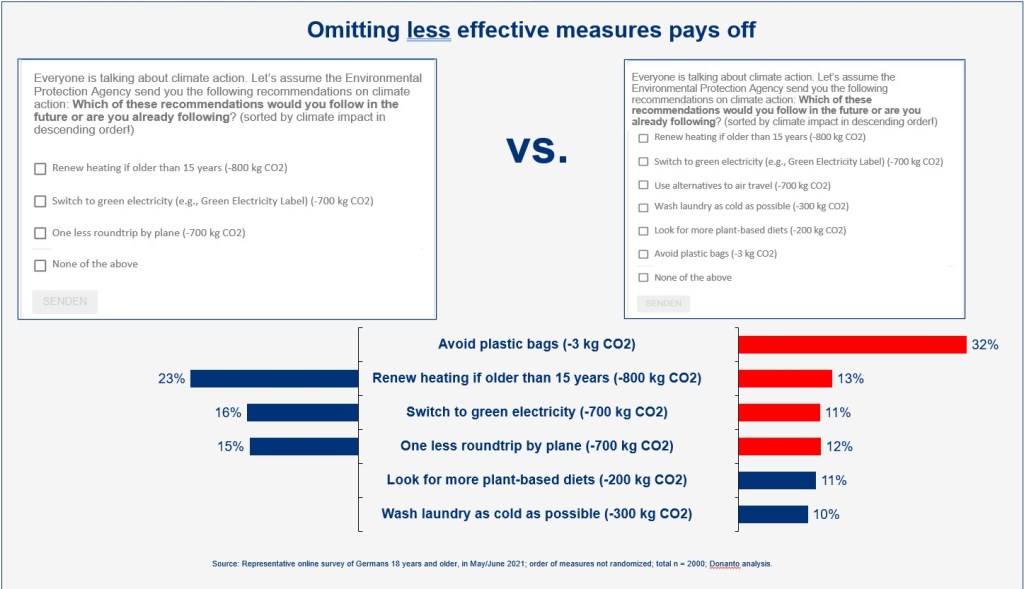
To measure the extent of improvement, I presented such an optimized checklist to 1000 people and asked them to select the measures they wanted to follow themselves. 1000 other people (again, representative of German online users) were shown the original checklist (without CO2 savings, measures in randomized order). The comparison of the results was shocking (see the following figure as an example): Sorting and information did not lead to any improvement in the choice of measures! And it was particularly shocking that most of the respondents still selected plastic bags, although it was clearly visible that the CO2 effect is negligible!

One obvious assumption is that we choose the measures that we find particularly easy to implement. But the results of my survey already cast doubt on this, namely when heating replacement (costly, time-consuming) is chosen more frequently than switching to green electricity (cheap, quick). In fact, according to the PACE study, many measures do not differ in their perceived simplicity by the respondents, only “climate-friendly home appliances” are rated slightly more difficult (3.7 out of 7) than the other measures (~4.5 out of 7):

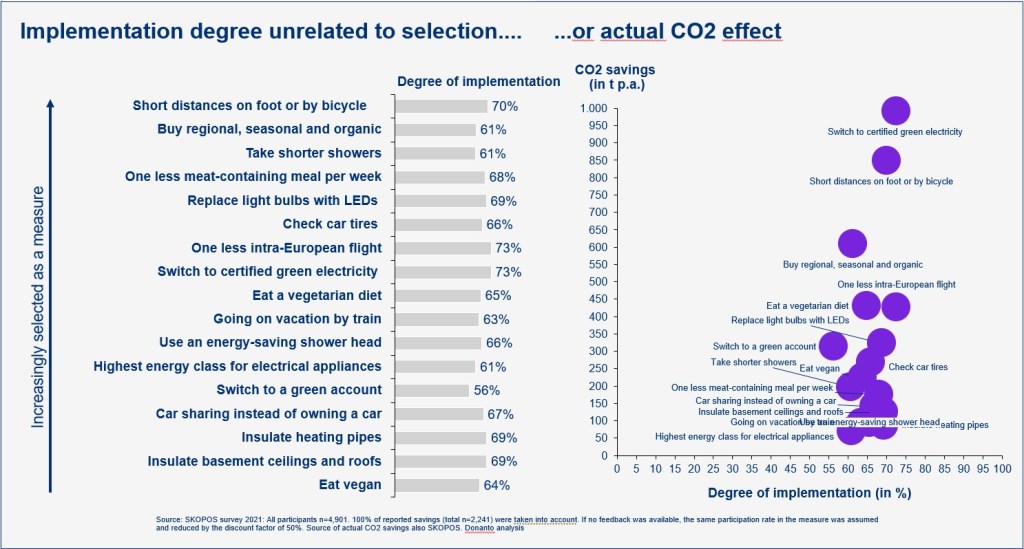
Or consider the following evidence: The “Climate Bet” campaign tried to get people to take effective climate-friendly actions. At the end of this campaign, a survey asked which of the originally selected measures were actually implemented by the respondents in their everyday lives. It turned out that the degree of implementation correlated neither with the popularity or simplicity (=initial selection) nor with the effectiveness of the individual measures: 

That wouldn’t be a problem if each of us took a variety of actions to combat the climate crisis. However, in about a dozen surveys in several countries with a total of more than 10,000 respondents, I have not once managed to get respondents to take more than two actions on average! The average is 1.5 measures, regardless of whether one asks about one’s own plans or about the less socially desirable question of what measures friends and acquaintances are likely to take. In addition, the “spillover” effect from climate-friendly measures to further measures is very difficult to achieve in reality, as the EU-wide CASPI project has shown.

Thus, if our advice simply omits the less effective measures, the climate impact of climate communication can be dramatically increased, as the following two surveys show by comparison:

I conducted a similar test based on the BMWK campaign in August 2022 with 2000 respondents, using the BMWK measures and wording: Focusing on the more effective measures did persuade significantly more respondents to pursue an effective measure (in this case, heating one degree less):

The one-minute commercial by Leaders for Climate Action therefore does everything right from this perspective! The next question is whether this is enough for success.

4. Focus on viral climate communication!

In a nutshell: Even well-done climate communication is too expensive using classic marketing means if it is to have a measurable climate impact at the national level. Viral campaigns in social networks are a possible alternative to roll out effective climate communication at a reasonable cost.

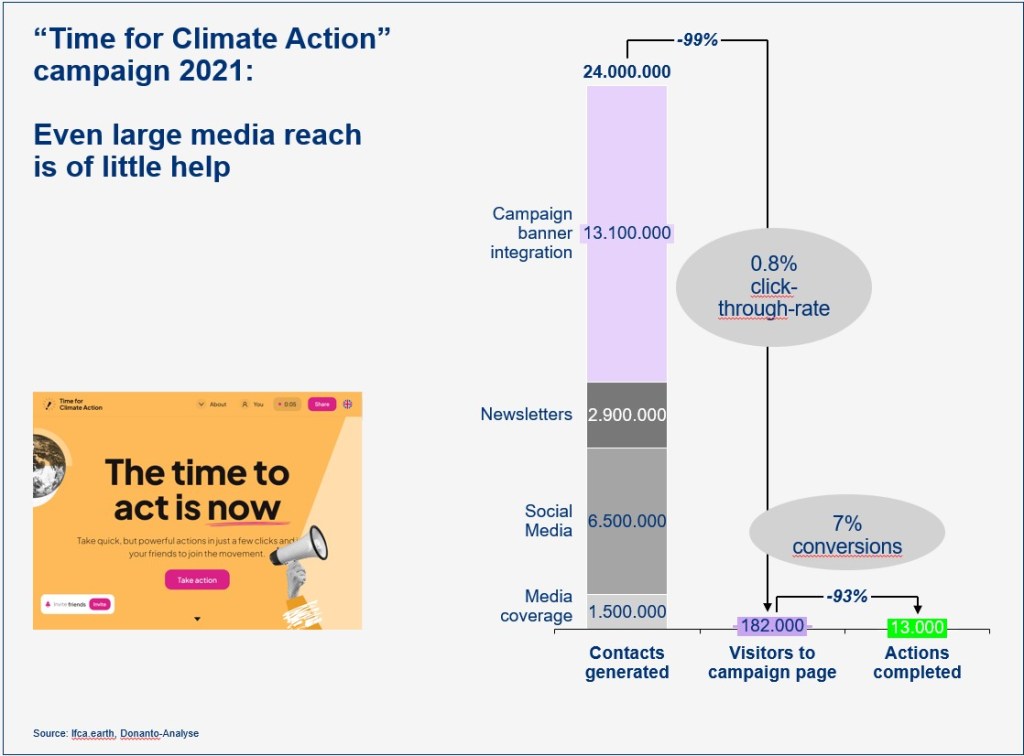
The “Climate Bet” campaign (see above) ended in great disappointment despite its excellent ideas: Of the targeted 1 million (saved or offset) tons of CO2, only around 20 thousand were achieved. Was this due to a lack of marketing know-how? Let’s take a look at a different campaign: In 2021, Leaders for Climate Action (LFCA) succeeded in generating 24 million contacts with its climate communication within a very short time through a large partner network of digital companies. The majority of these contacts were generated via campaign banners on partner sites and they generated almost 200 thousand visits to the campaign website. However, this only resulted in 15 thousand self-commitments to climate actions. So, despite impressive media presence, this outstanding campaign only persuaded a tiny fraction of German citizens to take climate-friendly action:

The marketing figures for this campaign are quite respectable (0.8% click-through rate and 7% conversions on the landing page). This is also evident when comparing it to key figures of the 2022 campaign: There, LFCA was able to reach 85 million people, but the number of people who registered for concrete climate protection measures on the landing page was still in the range of a few thousand, not least because the marketing metrics had deteriorated (0.2% click-through rate, 3% conversions).

A simple “back-of-the-envelope” calculation shows the resulting challenge of classic marketing communication:

Let’s assume we want to persuade enough citizens to take personal action that the effect would be measurable nationwide. To do this, we need – conservatively estimated – at least 10 million people who implement at least one effective measure, e.g., heating one degree Celsius less. If we apply the marketing metrics of the LFCA campaigns (see above), we would need to generate between 125 to 333 million clicks online for this. With common costs of 0.5 to 1.5 € per click (“CPC”), the pure communication costs for this one measure would therefore be between 62 and 500 million euros! By comparison, the BMWK campaign cost around €33 million by the end of November 2022, and Germany’s largest advertiser, Procter & Gamble, spends just over €1 billion a year on advertising. This means that measurably effective climate communication using classic marketing tools is simply too expensive for most players.

Would a PR strategy (i.e., distributing the measures via editorial contributions in the media) be an alternative? The PACE study has shown that trust in the messengers of climate communication is a key driver of willingness to act. Unfortunately, the PACE study also showed that trust in public service broadcasters is similarly poor to trust in the federal government (3.4 out of 7 on a scale of 1 – very little trust – to 7 – very high trust). In contrast, trust in “people and groups who share content on social networks” is significantly higher (4.3 out of 7; trend: increasing).

Therefore, the only way to have measurably effective climate communication at a reasonable cost seems to be via viral campaigns in social networks. (I described a possible approach to this in my TEDx Talk.) In viral communication campaigns, readers themselves take charge of spreading the messages, typically at no additional cost, via social networks and/or electronic messaging, so that no further media budget is required. Unfortunately, this is easier said than done, not least because research in this area is still in its infancy. Meaningfulness of the content and emotional arousal motivate at least some of the readers to forward (cf. Borges-Tiago et al. 2019, Botha, Reyneke 2013)

5. Focus initially on actions targeting heavy polluters!

Heavy polluters such as frequent flyers contribute disproportionately to the climate crisis, but it has been proven that they can hardly be reached by exhortations. Systemic measures such as progressive increases in the cost of frequent flying are an effective lever in this area and are likely to increase acceptance of measures that affect the general public.

The higher our income, the higher our expenditure, the more we consume and the larger our CO2 footprint (depending on the country and time period, a 10% increase in income increases the CO2 footprint by 6 to 8%, see meta-study by Pottier 2022). This leads to a gap in the CO2 footprint between high and low income households by a factor of 10 or more (see Weber, Matthews 2008). An important driver of this is personal flight behavior. As an example, I have calculated this using Lufthansa’s frequent flyer program: The flights that get you “Lufthansa Senator” status quadruple (!) your personal carbon footprint, compared to the national average:

It is estimated that the number of German frequent flyers is between 50 and 150 thousand people, significantly less than 1% of the population. A new study by Cass et al. 2023 diagnoses, based on in-depth interviews and focus groups with this target group, that “high-energy consumers may never voluntarily respond to information, exhortations, and appeals to self-interest. Instead, stronger state actions including those that impinge on ‘consumer freedoms of choice’ are required.” (My own experience with friends and family  fully confirms this.)

Thus, if personal measures fail for high-energy consumers, systemic measures are needed, e.g., progressively increasing the cost of frequent flights through taxes or even limiting flights per person. Acceptance according to a 2018 survey by Kantenbacher et al. is higher for taxation (3.1 vs. 2.7 on a scale of 1-strongly disagree to 7-strongly agree). The PACE study also showed that “taxing millionaires” (with the purpose of helping poorer countries meet climate change standards) receives significantly higher support than bans on certain modes of transportation (strong/very strong support: 61% for taxing millionaires vs. 34% for banning internal combustion engines from 2030).

In general, “pull” measures (e.g., financial incentives) have a higher acceptance than “push” measures (e.g., bans), cf. Drews, van den Bergh 2015. It will come as no surprise that support for any systemic measures drops significantly once respondents are traveling by air themselves (Kantenbacher et al. 2018, Hammar, Jagers 2007).

My hypothesis is that systemic measures for frequent flyers increase the overall acceptance of general measures that affect everyone because it increases perceived fairness (even though this aspect has not yet been studied in a dedicated way to my knowledge, there is empirical evidence for it, see Cai et al. 2010, Brannlund, Persson 2012, Gampfer 2014, Carattini et al. 2018). Therefore, systemic actions against heavy polluters can be key tools of climate communication to prepare the ground for broader action.